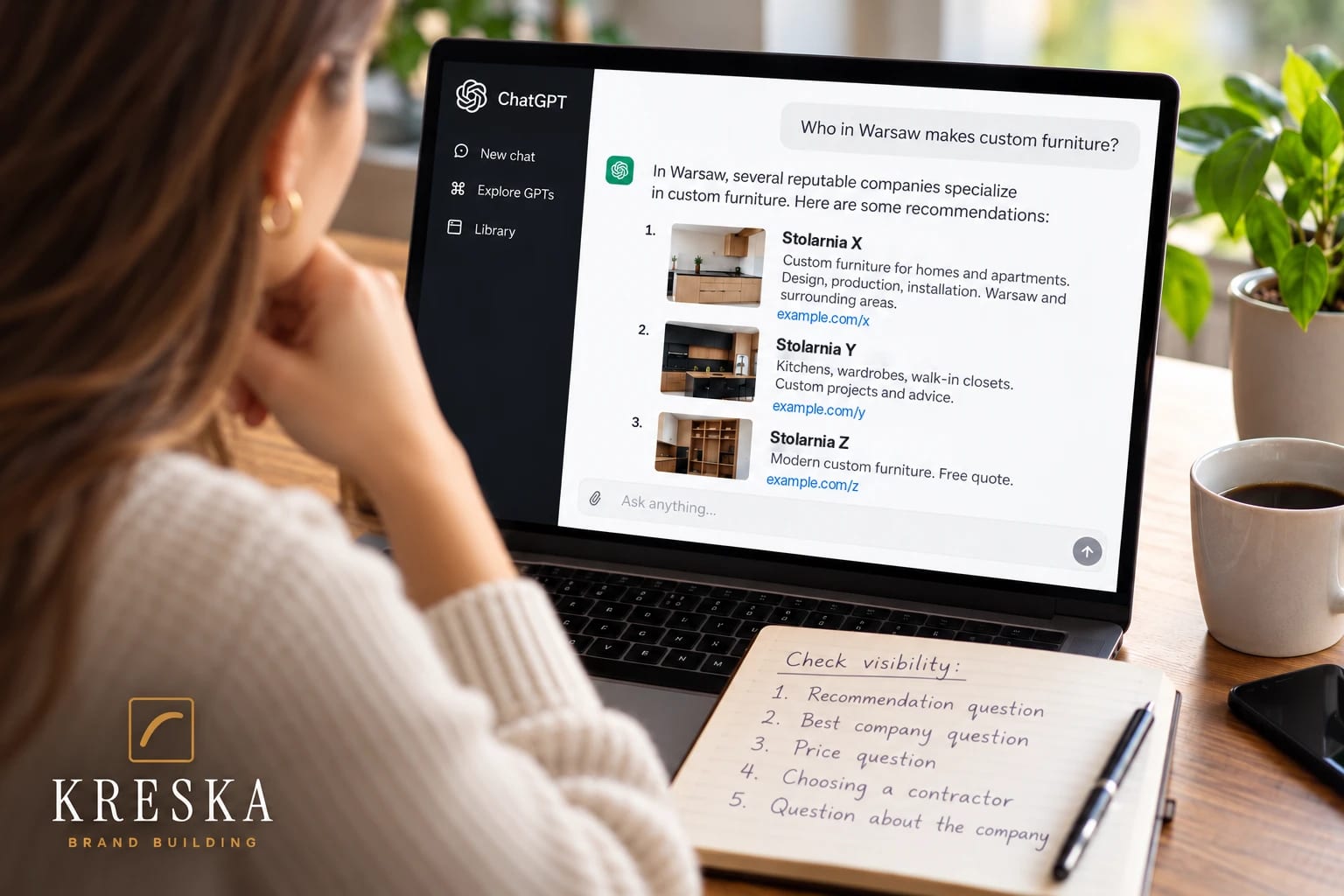
You check your business's visibility in AI answers by asking a model five questions a customer would ask and noting whether your business name appears in the answer. The test takes fifteen minutes and needs no tools. Repeated every month, it shows whether the work on your visibility is paying off.
Five questions
Replace the brackets with your industry and area, then ask each question separately in ChatGPT, Claude and Perplexity.
- A request for a recommendation: "Who near [town] can do [service] to measure?"
- A question about the best: "What is the best [type of business] in [area]?"
- A question about price: "How much does [service] cost in [town], and who does it?"
- A question about choosing a contractor: "How do I choose a good [trade], and who would you recommend in [area]?"
- A question about you directly: "What do you know about [business name] in [town]?"
How to read the results
| What you see | What it means |
|---|---|
| Your business name in the answer | The model has data about you and considers it reliable. Goal achieved. |
| Only your competitors' names | Your competitors have more consistent, better-described data. This gap can be closed. |
| A general answer with no names | Nobody in this industry and area is visible yet. Getting in is cheap. |
| Wrong details about you | The worst case. Somewhere online there is conflicting information about your business. |
The last question matters most
Asking about your business name directly tests accuracy more than visibility. If the model gives the wrong address, an old name or a service you don't offer, there is conflicting data about you online, most often in your Google Business Profile, an old industry directory or an out-of-date profile.
What to do if you're not there
- Structured data on your website - a machine-readable description of your business: type of business, address, service area, services, opening hours.
- Content in question-and-answer form - written exactly the way customers ask. A short answer right under the question is easy to quote in full.
- An llms.txt file - a short file on the server that states plainly who you are and what is worth quoting. It's a proposed standard: not every AI tool reads it, but adding it costs nothing.
- One version of the facts - the year you were founded, your service area, your list of services. With contradictions, the model can't tell which version is true.
- A presence in the sources models use - your Google Business Profile, industry directories, professional profiles.
Why this is starting to matter
A classic search engine shows ten links and the user chooses. A language model answers with one paragraph naming two or three businesses. There's no second page of results, so the difference between first and fourth place disappears: there is only being there or not being there.
In most local industries, competitors aren't doing anything about this yet. That's why today a properly described website and consistent details are enough, while in two years this will cost as much as classic SEO does today.
A note on repeatability
Models don't give the same answer every time, and some of them search the web as they answer. That's why it's worth running the test in three tools and repeating it the following month, rather than drawing conclusions from a single answer.