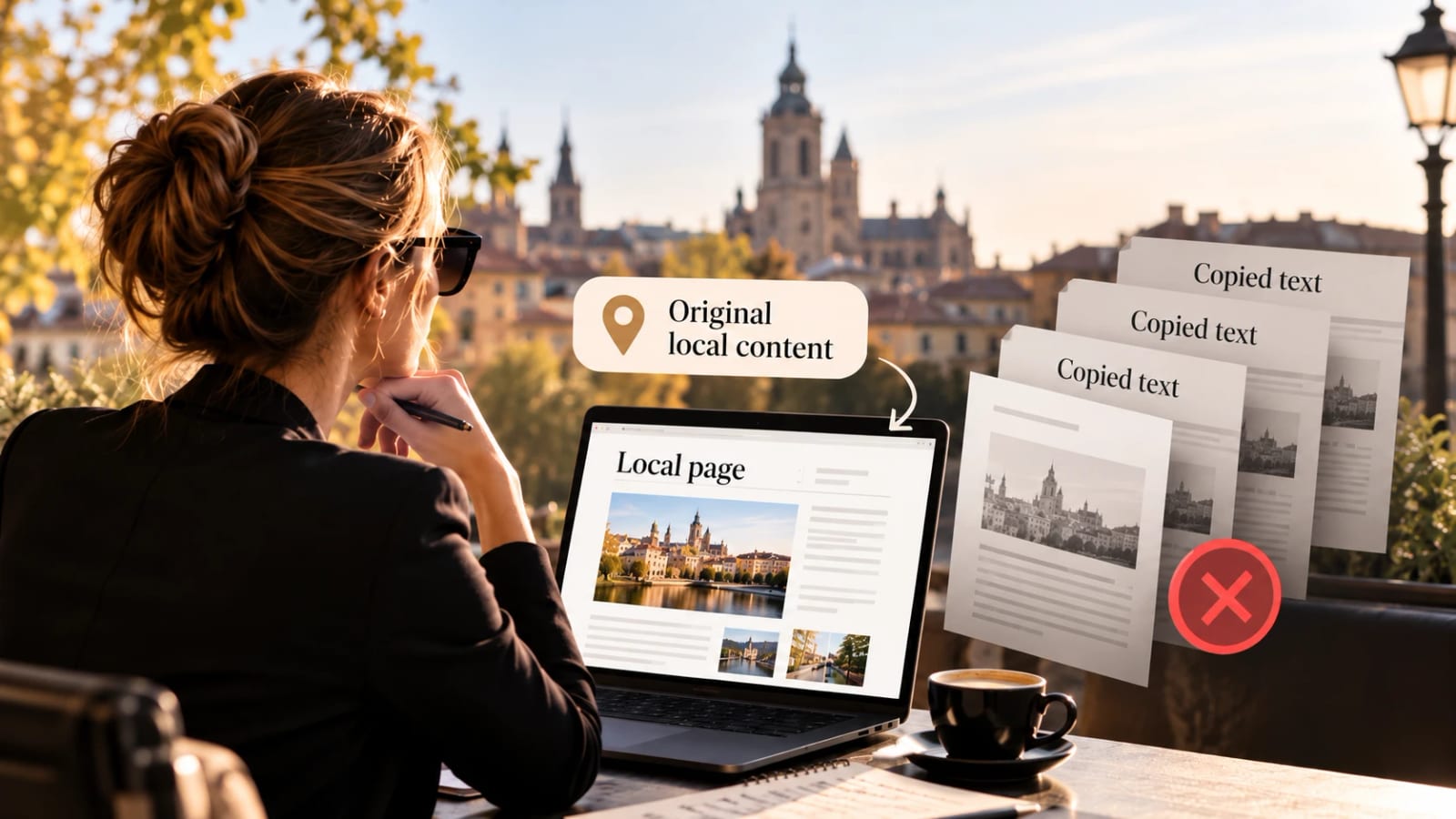
A local page is a separate page about one service in one city, with its own address, its own title and unique content about that city. A list of town names in the footer isn't a local page and has no effect at all. In its spam policies, Google lists blocks of text naming cities as an example of keyword stuffing.
Why a list of towns in the footer doesn't work
Google matches results to where the user is and shows pages that contain content about that place. The sentence "we cover a fifty-kilometre radius" isn't content about any particular town.
Someone thirty kilometres away who types in the name of the service will see businesses that have a page about their town. They won't see the one that mentioned their town in a list at the bottom of the home page.
What a good local page consists of
| Heading | Service plus town plus area, for example "Custom metal staircases in Massy (91)" |
| Introduction | Two or three sentences about the town: the type of buildings, common jobs, travel time from your base |
| Past work | At least one photo of a project from the area, with a description of the material and the solution |
| Options | Specific types of product or service, not general slogans |
| Process | Measuring, design, making, fitting, with real timescales |
| Local FAQ | Three to five questions, for example about an extra charge for travel |
| Contact | A quote form and a phone number visible without scrolling |
The mistake that costs the most
The most common temptation is to write one text and copy it eight times, swapping the name of the town.
In the same policies, Google describes pages aimed at one city after another as doorway pages. Pages like that usually don't rank, and in the worst case they drag down the rating of the whole website.
A search engine compares the content of pages within one domain. Eight almost identical texts that differ by one word are a pattern algorithms have been detecting for years. The result can be that Google picks one page as the right one and ignores the other seven, or lowers its quality rating for the whole site.
How many local pages to create
As many as you can write honestly and differently. In practice that means five to eight to start with, not eighty.
We start with the most valuable combinations: the biggest town in your area times the service with the highest margin. We add more after two or three months, based on Search Console data, where impressions are already showing but dedicated content is missing.
Where to get content so it isn't a copy
From one conversation with the owner: where the latest installations were, what was difficult about them, which materials were used, how long the journey took, what type of building it was. An hour's conversation is enough for a full set of eight pages, each saying something different.
When local pages don't make sense
- You work in one town. Then one good service page and a Google Business Profile are enough.
- You sell by mail order across the whole country. The customer's location doesn't matter, so local content won't bring in enquiries.
- You have no past work from those towns. A page with no photo and nothing specific will be empty, and it's better not to make an empty one at all.