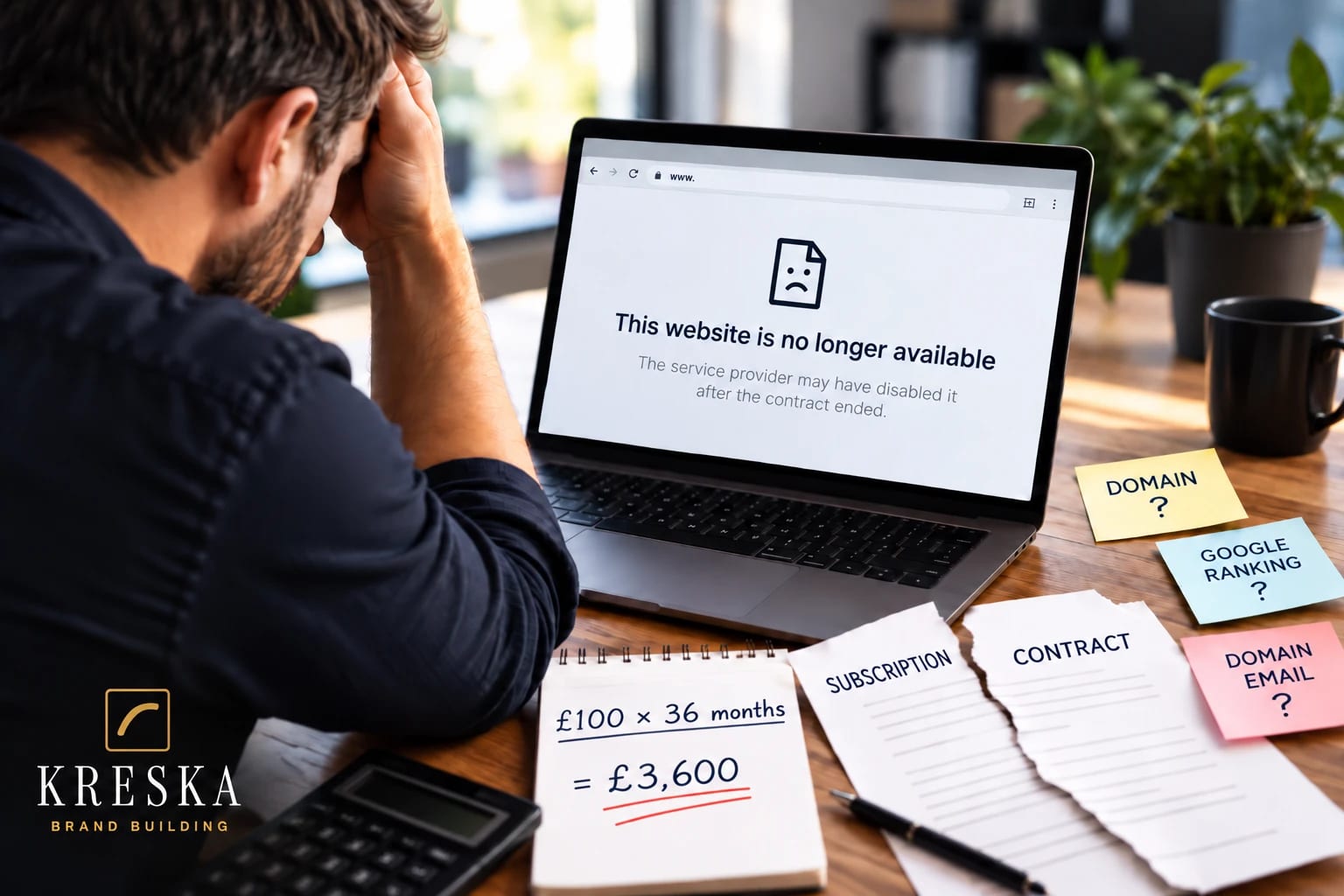
Under most subscription contracts, the website never becomes the business's property: when you cancel, it stops working, and the search rankings built up over years disappear with it. You're paying rent, not paying for a build, and after three years you have nothing you can take elsewhere.
The sum nobody does when signing
100 a month is 1,200 a year. Over a typical three- to five-year contract, that adds up to between 3,600 and 6,000.
That's comparable to a one-off build of a website you own, with one difference: after a one-off project the website stays, while after a subscription all that's left is the cancellation notice.
Three questions to ask before signing
- Who owns the domain? Check that you're listed as the owner, not just as the contact person. This is the most important point in the whole contract.
- What happens to the website when you cancel? If the answer is "the site is switched off", you're renting. If it's "we hand over the files", you own it.
- Will we get the code and the content? Without them, moving to another developer starts from zero, including rewriting the copy.
What you really lose along with the website
Your Google rankings
Page addresses, links pointing to them from other websites and the site's history are an asset built over years. Once the website is switched off, those addresses stop working and a new site starts from zero, even if its content is better.
This can be rescued with redirects from the old addresses to the new ones, but only if you control the domain. If the domain is registered to the provider, there's nothing to redirect.
Your email address on the domain
Mailboxes on the domain usually run as part of the same service. Losing the domain means losing the address your customers have been writing to for years.
The ability to change anything
With a subscription model, you usually can't add pages for specific towns or services, because the template doesn't allow it. That means that even while paying, you can't do any meaningful local SEO.
When a subscription is fine
The distinction is simple: a subscription for maintenance is not the same as a subscription for existing.
| A fair model | A rental model |
|---|---|
| You pay for the build once, and the website is yours | You don't pay for the build, you pay monthly |
| The subscription covers the server, backups, updates | The website only works while you pay |
| Cancelling: you get the files, the website keeps running | Cancelling: the website disappears |
| The domain is registered to your business | The domain is registered to the provider |
A monthly fee isn't a problem in itself. The problem is a contract where stopping paying means ceasing to exist online.
What to do if you're already in a contract like this
- Check who owns the domain in the public WHOIS database. It takes a minute and is the most important piece of information.
- Read the contract for what the provider was supposed to deliver. Obligations that weren't met can be grounds for ending the contract.
- Save your content and photos before you do anything else. Saving the copy and images to your own drive doesn't need anyone's permission.
- Don't switch off the old website before the new one is live. Running both in parallel for a few weeks lets you move the traffic over without a gap.
- If there's a dispute, talk to a lawyer. A web studio can prepare documentation and an audit, but it can't replace legal advice.