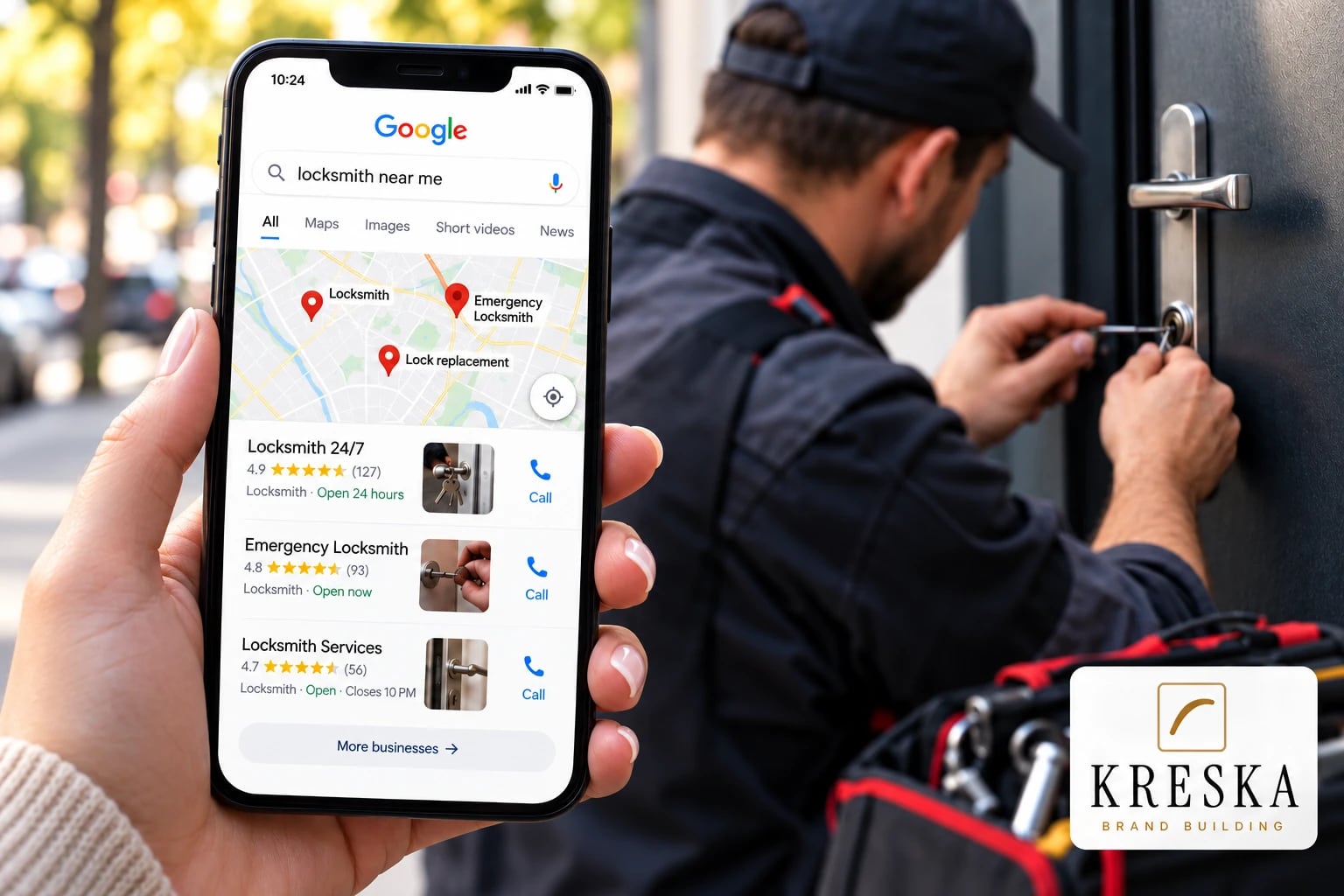
This is a model audit that shows how we work. It doesn't describe a specific business and doesn't attribute to anyone mistakes we haven't checked.
What we check first
We don't start by publishing posts or by adding keywords to the business name. First we check whether Google is getting unambiguous information: what the business does, where it actually serves customers, whether the details on the website match the details in the profile, and whether the profile gives customers enough reasons to choose this particular business.
Google itself says that local results depend on three factors: relevance, distance and popularity. You can't change distance, but you can work on the other two.
Seven mistakes, one by one
1. The wrong or too broad a primary category
The primary category tells Google what the business is. If a locksmith picks a category that's too general or only loosely related to the service, they'll start appearing for less relevant searches.
What we fix: we choose the category that best describes the core business, and add secondary categories only when they match real services.
2. A service area set "just in case"
A local business doesn't gain credibility by listing the whole country. The service area should match the places the team actually travels to.
What we fix: we set specific towns or areas and make sure the same information is on the website.
3. The profile says "locksmith" but not what exactly they do
Customers are looking for a specific solution: emergency door opening, lock replacement, repairs after a break-in, fitting security locks. If the profile and the website don't name these services, Google has less context and customers have fewer reasons to click.
What we fix: we complete the list of services and describe them in the customer's plain language.
4. The photos are old or random
For local services, photos are proof that the business is really working. A blank logo, a stock photo and three pictures from two years ago don't build the same trust as recent work.
What we fix: we regularly post real photos of the work, the team, the tools and the results, without customer details and without sensitive security specifics.
5. The reviews are good, but there haven't been any new ones for a while
The average rating is only part of the picture. Customers also look at whether the reviews are recent and whether the owner replies.
A profile rated 4.9 with no new review for a year looks less active than a competitor getting two reviews a month.
What we fix: after each completed job, we send the customer a simple link to leave a review and reply to every review. We don't buy reviews or reward anyone for a particular rating.
6. The business details differ between the website and the rest of the internet
A different phone number on Facebook, an old address in a directory, a shortened name on the website and the full name on Google add up to a mess. To a person it's a detail; to a search engine it's several versions of the same business.
What we fix: we bring the name, phone number, website address, service area and business description into line everywhere we have control.
7. The profile leads to a home page that says nothing about the local service
If the home page covers ten services and many regions, Google and the customer have to guess where to find the answer. A strong page for a specific service or town is usually a better destination.
What we fix: we build a local page with unique content, the scope of the service, examples of past work, a questions section and a clear call to get in touch.
A plan for the first thirty days
| Week one | Make the name, phone number, website address and service area consistent across all sources |
| Week one | Check the primary and secondary categories |
| Week two | Complete the list of services and the business description in the customer's language |
| Week two | A full set of recent photos: the work, the team, the results |
| Week three | Start the review collection process and reply to all existing reviews |
| Week four | Link the profile to the right service or local page |
| Week four | Check the website's indexing and the consistency of the business details |
Where GEO and AI answers come in
AI models and AI-powered search engines use the information available online. That's why local SEO and GEO aren't two separate worlds. A consistent business name, specific services, a website that answers customer questions, up-to-date information and structured data help search engines understand exactly who the business is and when it's a relevant result.
There's no single file or tag that guarantees being cited by AI. We build a set of consistent signals and then check whether visibility really grows. We write more about this in the article does AI recommend your business.
What we don't do in an audit like this
- We don't add keywords to the business name. Google treats it as a breach of its guidelines and can suspend the profile.
- We don't create extra profiles for the same addresses. Duplicates split the reviews and lower the visibility of both profiles.
- We don't promise first place by a specific date. We can promise a full set of correct signals and regular measurement.